A Force in Physics: Unveiling the building blocks of the universe, one experiment at a time.
Discover Her Story
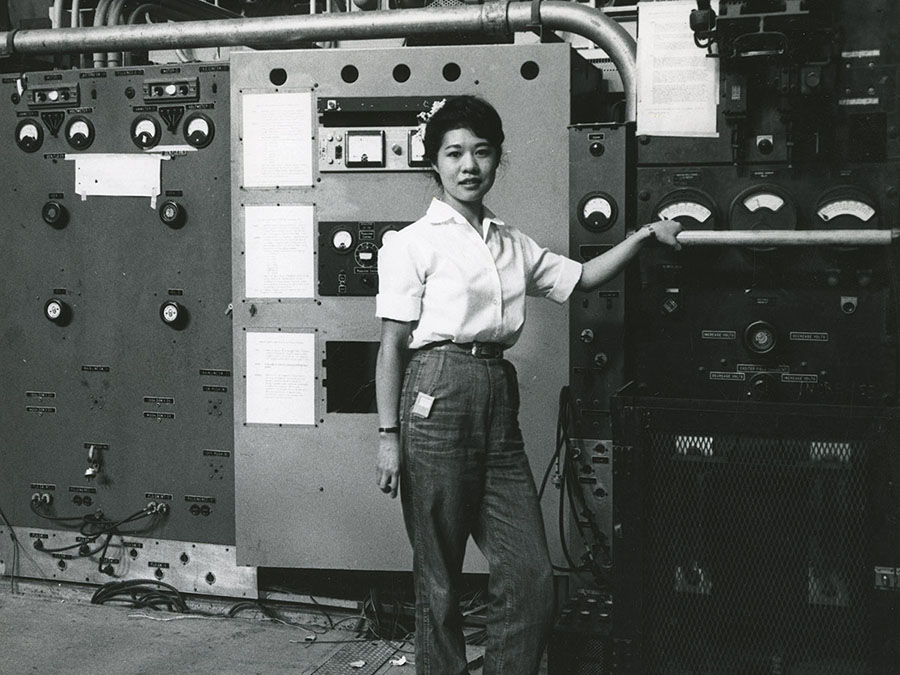
Dr. Juliet Lee-Franzini (October 25, 1933 – January 20, 2014) was a distinguished Chinese-American experimental particle physicist. A trailblazer for women in STEM, she dedicated her career to unraveling the fundamental forces and particles governing our universe through meticulous experimentation and leadership in major international collaborations.
Born in Peking and educated in the US, she earned her Ph.D. from Columbia University under Nobel laureate Leon Lederman, setting the stage for decades of groundbreaking research.
Born in Peking, China. Earns Ph.D. in Physics from Columbia University under Leon Lederman, researching muon decay.
Becomes a founding faculty member of the high-energy physics group at Stony Brook University.
Leads crucial research with the CUSB collaboration at Cornell, studying the Upsilon meson and properties of the beauty quark.
Elected Fellow of the American Physical Society (APS). Contributes to the DZero experiment at Fermilab (Top Quark discovery).
Co-founds KLOE collaboration at Frascati, Italy, studying CP violation in kaons. Becomes Director of Research at LNF (INFN). Passes away in 2014.
Dr. Lee-Franzini's experimental work explored the fundamental particles and forces shaping reality, from common particles like electrons to exotic ones like quarks.
Her PhD thesis involved precise measurements of muons (like heavy electrons), setting limits on rare ways they might change (decay) and giving insights into the weak nuclear force – crucial for processes like radioactive decay.
Key Discovery: Strict limits on μ → e + γ decay.
Think of the protons and neutrons you learned about in chemistry – they're made of fundamental particles called quarks! Dr. Lee-Franzini led studies of the Upsilon (ϒ) particle, which is made of a heavier, rarer type called a 'beauty' quark (b) and its antimatter partner (anti-b). Studying Upsilon revealed key properties of the beauty quark.
Key Discovery: Detailed properties of the Upsilon meson system.
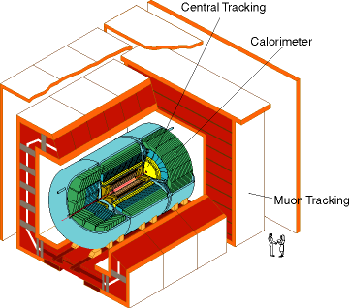
She contributed to the DZero experiment, which co-discovered the 'top' quark – the heaviest known fundamental particle. Finding it completed a crucial piece of the particle puzzle physicists call the Standard Model.
Key Discovery: Co-discovery of the Top Quark.
Why is the universe made of matter, not antimatter? Dr. Lee-Franzini co-founded the KLOE experiment to study tiny differences (CP violation) in how certain particles (kaons) behave compared to their antimatter versions. Understanding this asymmetry is key to solving the matter-antimatter mystery.
Key Discovery: High-precision measurements of CP violation parameters.
Dr. Lee-Franzini was instrumental in establishing Stony Brook University's reputation in high-energy physics. Joining in 1963 as a founding faculty member of the experimental group, she rose to Professor in 1974, mentoring students and contributing significantly to the department's research excellence for decades.
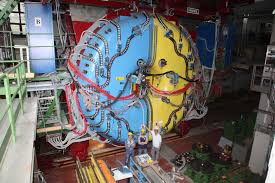
Her research required massive machines and international teamwork. She collaborated and conducted experiments at leading physics laboratories across the globe, including famous sites like Cornell University, Fermilab near Chicago, and the Frascati National Laboratories in Italy.
During her impactful tenure at Stony Brook, Dr. Lee-Franzini worked alongside other leading academics, including Professor Aria Kaufman, my grandfather!
While their primary research areas differed—particle physics and computer science/visualization—the university fostered an environment of interdisciplinary support. The sophisticated data analysis, simulation, and visualization techniques developed within Computer Science, potentially influenced or supported by Prof. Kaufman's group, were increasingly vital for processing the massive datasets generated by the complex particle physics experiments Dr. Lee-Franzini helped lead. This synergy highlights the collaborative nature of modern scientific breakthroughs.
Despite profound contributions, Dr. Lee-Franzini isn't a household name, partly due to the specialized nature of particle physics and historical biases affecting the visibility of women scientists.
Her story is vital: it showcases the dedication required for fundamental discovery, highlights the importance of diverse voices in science, and provides a powerful role model for aspiring physicists everywhere. Understanding her work illuminates the process of modern science itself.
Sources consulted for this project: